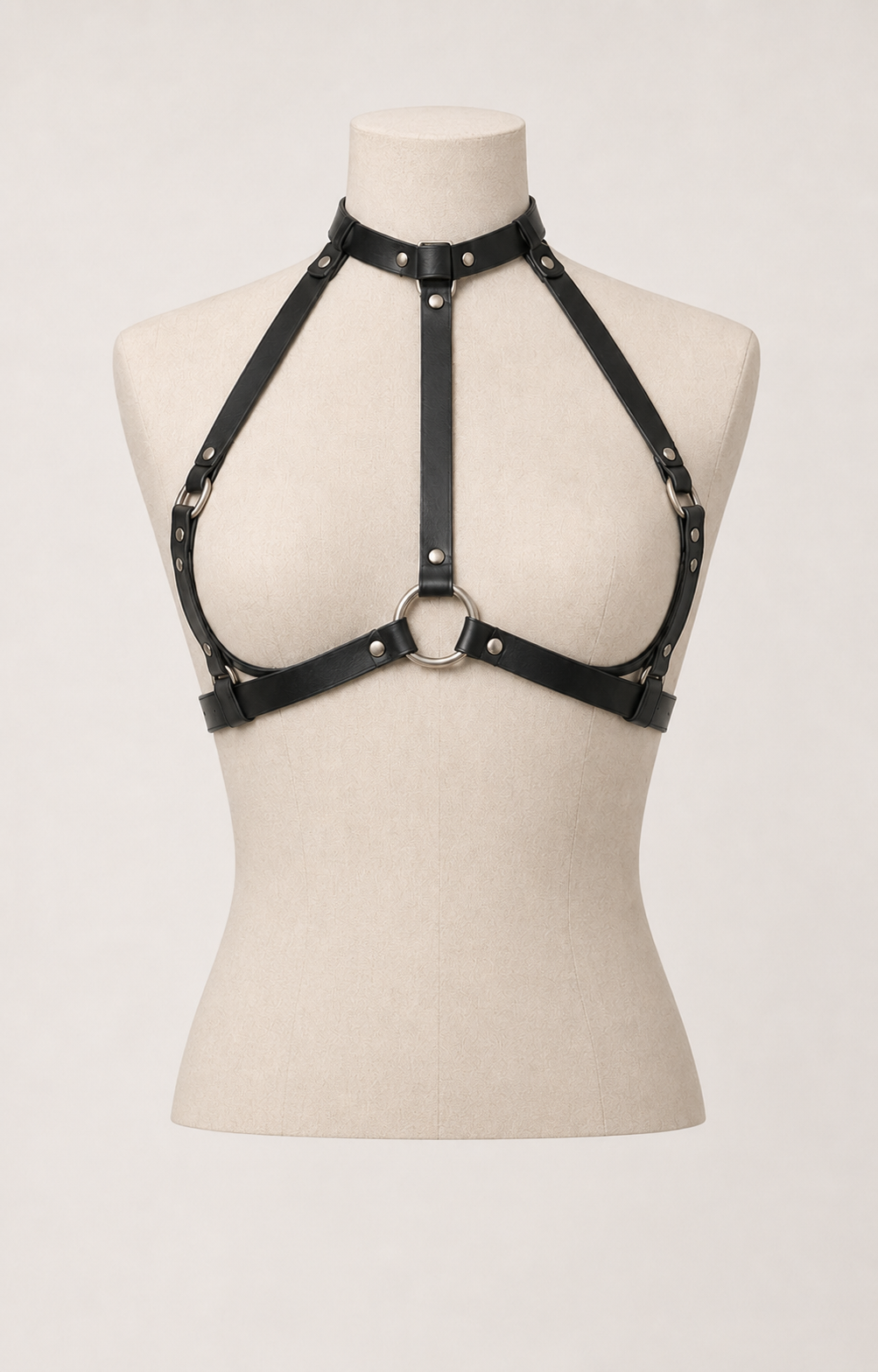
The word “harness” rarely brings a garment to mind. It immediately conjures a specific image (a bedroom, a club, a “scene”) before we even know what we're really talking about. That's understandable: it's roughly the only image the industry has ever shown. So let's start from the beginning, plainly.
What a harness actually is
Technically, a harness is an arrangement of straps worn over or under a garment, assembled with rings and buckles, that structures the body and draws the eye to certain areas. It's exactly the same principle as a wide belt, a structured bustier, or a crossbody bag, except it's been left for decades to the aesthetic of a single context.
Where the unease comes from
A harness isn't inherently shameful, it's the industry that made it feel that way. Cheap materials that age badly, discount packaging, dated websites, messaging that leans on embarrassment rather than style: everything was designed for a niche audience, never meant to be shown. The unease you feel looking at a harness comes from that aesthetic, not from the object itself.
“A garment should never need to be justified in order to be worn.”
Why you're seeing it more, outside any intimate context
In recent years, the harness has stepped out of its original niche to become a fashion piece in its own right: worn under a blazer, over a dress, as a full look for an evening out, as an accessory that structures a silhouette. None of that needs any connection to sexuality to exist, it's a matter of style, the same as choosing a piece of jewellery or a belt. And for those who also use it in a more intimate setting, the same piece can serve both purposes perfectly well.
If you use it in a more intimate context
Nothing complicated to add here, just a common-sense reminder that applies to any activity shared between partners: talk about it beforehand, make sure the other person is comfortable, and always keep the option to say stop at any moment, with no justification required. Everything else (the pace, the intensity, the staging) belongs only to you and your partner.
How to choose your first harness
Three criteria are enough to get it right: a material that holds up over time (genuine vegetable-tanned leather develops a patina instead of cracking), adjustable buckles rather than a fixed size to suit your body, and a simple design for a first purchase, more elaborate pieces will come naturally once you've found your style.
In short
A harness is a garment like any other: a matter of material, cut and personal taste. Whether it becomes part of your everyday wardrobe, an evening look, or a more intimate moment, it needs no justification to exist in your closet.
Discover the collection